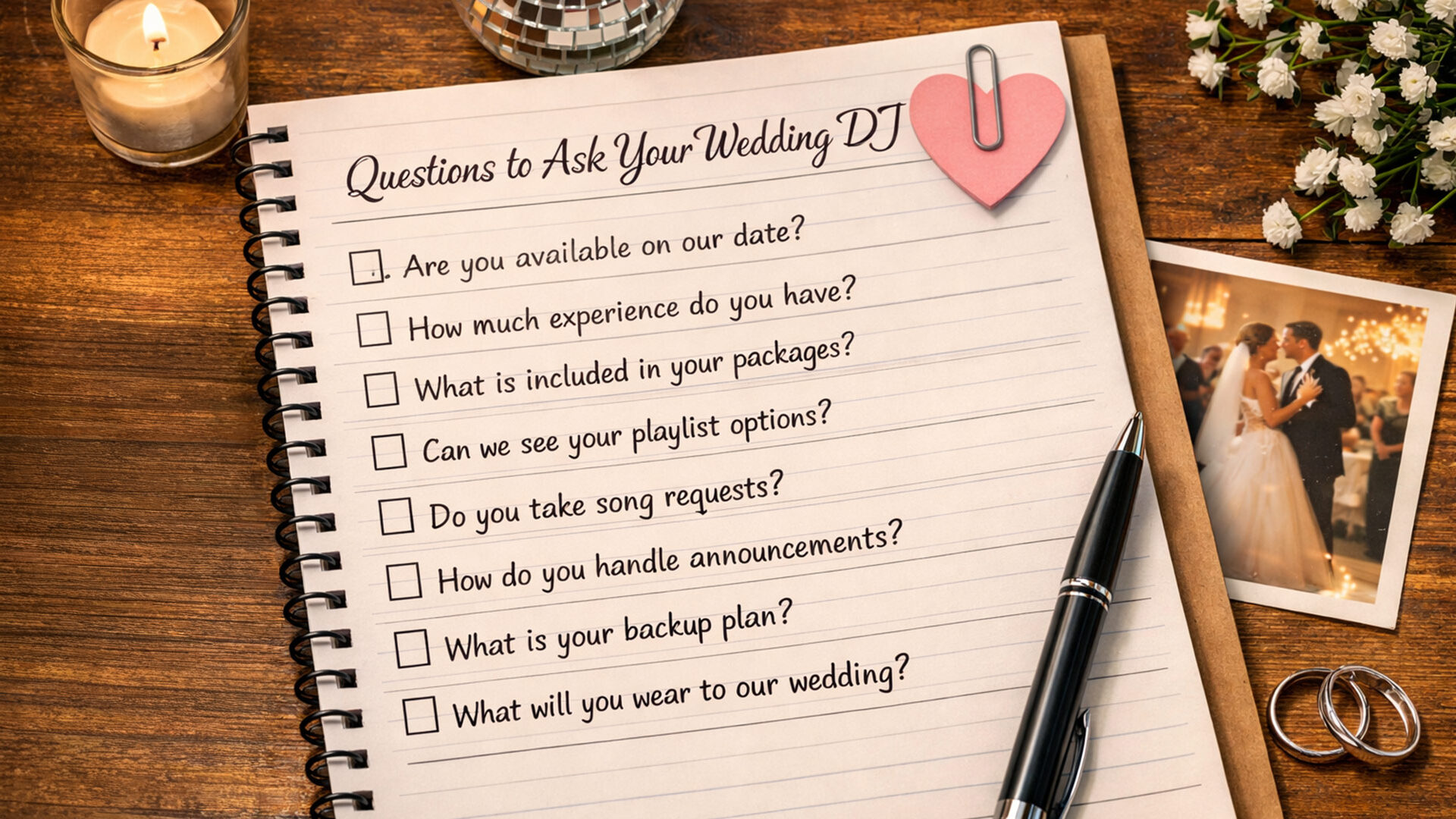
When couples ask us what they should look for in a wedding DJ, we usually say: don’t start with playlists; start with process.
The right questions will reveal:
- whether the DJ can actually MC (not just “talk”)
- how they prevent awkward downtime
- how they handle ceremony audio and toasts
- whether they have professional backup standards
Use this list to interview every vendor the same way so you can compare fairly.
Quick note: what “good answers” sound like
A great DJ answers with:
- specific examples
- a clear process
- calm confidence
- details about backup standards
A weak DJ answers with:
- vague hype (“we get everyone going!”)
- dodging details
- no clear plan for sound and flow
The questions (and what to listen for)
Experience and specialization
-
How many weddings did you DJ/MC in the last year?
Good: weddings are a major focus and they can speak confidently about typical timelines. -
Will you personally be the DJ at our wedding?
Good: clear staffing plan and who your point of contact is. -
How would you describe your MC style?
Good: “warm, professional, efficient” with examples.
Red flag: “I’m super hype” with no detail.
Planning process and timeline
-
What does your planning process look like?
Good: structured call(s), forms, timeline help, coordination with planner. -
Do you help build our reception timeline?
Good: yes, and they explain how they collaborate with other vendors. -
How do you handle last-minute changes?
Good: calm process; they confirm readiness before announcements.
Ceremony and toast audio
-
What microphones do you use for ceremony and toasts?
Good: clear mic plan (officiant/vows/reader).
Red flag: “We’ll just use a handheld mic” for everything. -
How do you prevent feedback (the squeal)?
Good: placement + gain structure + testing + experience. -
If our ceremony site doesn’t have easy power, what’s the plan?
Good: battery/wireless solutions and clean setup.
Music strategy
-
How do you handle mixed crowds and different age groups?
Good: strategy for energy waves and genre bridging. -
Do you take guest requests? How do you filter them?
Good: requests welcomed but aligned to couple’s boundaries and dance floor. -
How do you handle do-not-play?
Good: respected as a hard boundary. -
Do you mix live, or mostly play full songs?
Neither is “wrong”; you just want the approach that fits your vibe.
Reliability and backups
-
What backup equipment do you bring?
Good: backup music source, microphones, cables, power. -
Are you insured?
Good: yes, and can provide COI if venue requests it. -
What happens if you’re sick or there’s an emergency?
Good: a written contingency plan and staffing support.
Logistics and details
-
When do you arrive for setup?
Good: early enough to be fully ready before guests. -
How much space do you need and how do you manage cables?
Good: clean, safe setup that won’t clutter photos. -
Can you share examples from a wedding similar to ours?
Good: they can show work in similar venues/crowds.
Red-flag answers (quick cheat sheet)
- “We don’t really do planning; just send a playlist.”
- “We don’t carry backup gear.”
- “We don’t use a contract.”
- “Our lights are sound-active; they just go with the beat.”
- “We can’t guarantee who your DJ will be.”
The bottom line
You don’t need a DJ with the biggest speaker or the biggest personality. You need a DJ/MC with:
- a professional planning process
- strong hosting skill
- reliable audio
- clear backup standards
If you want to talk through what you’re comparing (or what questions to ask based on your venue), we’re happy to help.
Next step: Check availability.
FAQs
How many DJs should we interview?
Two to three is usually enough. You’ll learn what “good process” sounds like quickly.
Can we ask for references?
Absolutely. Look for reviews that mention “smooth flow,” “clear audio,” and “kept the night moving.”
Should we prioritize price or experience?
Prioritize clarity, planning, and reliability. The cheapest option can become expensive if the night feels disorganized.