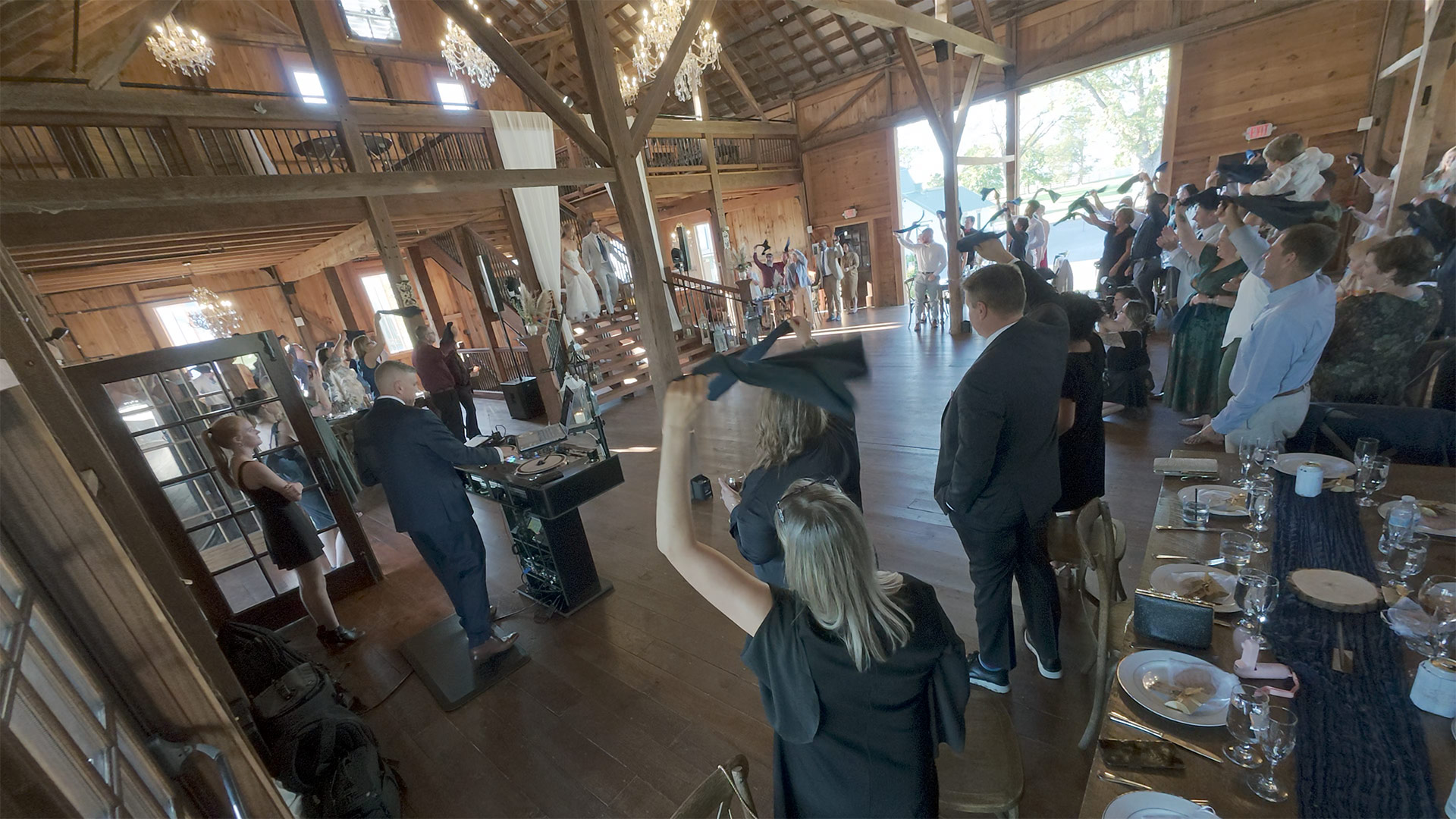
Picking your wedding DJ isn’t just picking music. You’re choosing the person (or team) who will control the pace of your reception, guide key moments, and protect the vibe when timelines shift (because they always do).
This guide is designed to help you choose with confidence, whether you’re comparing three vendors or trying to understand why quotes vary so much.
The biggest misconception: “Any DJ can do a wedding”
Plenty of DJs can play songs. A wedding DJ/MC has to do four jobs at once:
- Sound engineer: ceremony audio, microphones, room coverage, feedback control
- MC / host: confident, calm, clear announcements (without taking over)
- Producer: coordination with planner/venue/photographer so moments land perfectly
- Crowd reader: mixing and pacing that keeps the floor alive for your specific guests
When couples are disappointed with entertainment, it’s rarely because the DJ “didn’t have good songs.” It’s usually because the flow felt choppy, awkward, or unmanaged.
Your decision framework: the 6 things that predict a great reception
1) MC skill (not “talking a lot”)
A great MC is:
- Clear (you can understand them instantly)
- Confident (no nervous filler words, no rambling)
- Warm (friendly tone that fits a wedding)
- Efficient (keeps things moving without feeling rushed)
- Low-ego (the couple stays the focus)
Green flag: They describe how they’ll handle intros, toasts, and transitions in a calm, structured way.
Red flag: They sell you on “getting everyone hype” without explaining how they run real wedding moments.
2) Planning process (the “invisible” part of the service)
The best receptions feel effortless because planning happened before the wedding.
Look for a process that includes:
- A structured planning call (or two) where timeline + music preferences are mapped
- A way to capture pronunciations, family dynamics, “do-not-play,” and special moments
- Coordination with planner/venue/photographer for a shared timeline
If the planning process is vague, the wedding day becomes improvisation, and that’s when awkward gaps happen.
3) Professional audio (especially for ceremony + toasts)
Audio is where weddings can go sideways fast:
- Officiant mic squeals (feedback)
- Toasts that guests can’t hear
- Wind + outdoor noise swallowing vows
Ask specifically:
- What microphones are used for officiant + vows?
- How do they cover outdoor spaces without ugly cable runs?
- What’s the backup plan if a microphone fails?
Subtle local reality: outdoor and barn venues often have limited power near ceremony sites. Battery-powered or wireless options can make the difference between clean photos and cord chaos.
4) Music strategy (not just a playlist)
You want a DJ who can explain their approach to:
- Keeping energy consistent (no “dead air” vibe)
- Mixing style (quick-mix vs full songs; clean edits)
- Handling mixed crowds (age, culture, genre preferences)
- Managing requests (honoring guests without sacrificing your vision)
Tip: Ask them to describe a typical 30-minute stretch of open dancing: what they start with, how they build, how they pivot if the room changes.
5) Reliability and backup standards
Weddings are high-stakes. Pros plan for failure.
Minimum standards we recommend:
- Backup music source (laptop/controller redundancy)
- Backup microphones
- Spare cables, adapters, power
- Written contract + clear cancellation policy
- Liability insurance (many venues require it)
6) Fit (style, tone, and values)
Even a technically great DJ may not match your vibe.
Consider:
- Do you want club-style mixing or classic full-song dancing?
- Do you want the MC to be minimal or more interactive?
- Do you want to emphasize Latin/Caribbean, country, R&B, EDM, 00s, etc.?
You’re not hiring “the best DJ.” You’re hiring the best DJ for your wedding.
The wedding DJ/MC interview checklist (copy/paste)
Use this to compare vendors apples-to-apples.
Experience + approach
- How many weddings have you personally DJ’d and MC’d in the last 12 months?
- Do you specialize in weddings, or are weddings a small part of what you do?
- What’s your MC style in one sentence?
- Do you mix live, or do you mostly play full tracks?
- How do you handle a mixed-age crowd?
Planning + timeline
- What does your planning process look like (calls, forms, timeline support)?
- Will you help build a reception timeline?
- How do you coordinate with my planner/venue/photographer?
- How do you handle last-minute timeline changes?
Audio + gear
- What microphones do you use for ceremony and toasts?
- Do you provide ceremony audio? Cocktail hour audio?
- What’s your backup plan if equipment fails?
- Are you insured?
Music preferences + boundaries
- How do you handle do-not-play and must-play requests?
- Do you take guest requests? If yes, how do you filter them?
- Can you provide clean edits for explicit songs?
Logistics + staffing
- Who is showing up on wedding day (you or an assigned DJ)?
- What time do you arrive for setup?
- Are you fully self-contained (table, facade, cables, power)?
Red flags that couples often miss
- No structured planning (“Just send me a playlist”)
- No contract (or contract is vague)
- No backup plan (or they joke about it)
- Sound-active party lights that blink randomly all night
- They can’t explain their MC approach beyond “we’ll keep it fun”
- They can’t explain pricing (or pricing feels like mystery math)
What to do next (simple, low-stress)
- Shortlist 2–3 DJs that fit your vibe.
- Interview them using the same checklist.
- Ask for a sample timeline or how they’d run your key moments.
- Confirm backup standards, insurance, and staffing.
If you want, we can walk through your priorities and recommend an entertainment plan that fits your venue and guest list.
Next step: Check availability or explore wedding services.
The Sir Force standard
Everything outlined in this guide, from MC skill to vendor coordination to professional audio, is what we bring to every wedding. We work as the quarterback on your reception floor, coordinating with your Day-of Coordinator, photographer, and catering team to ensure seamless timing.
Our approach isn’t about “hyping up” the crowd. It’s about protecting your timeline, reading the room, and making sure your reception flows like you envisioned it.
See how we structure our wedding production →
FAQs
How far in advance should we book a wedding DJ/MC?
Many peak dates book 9–18 months out. If your date is a Saturday in peak season, earlier is better, especially if you want a specific DJ/MC.
Do we need an MC if we have a planner?
A planner manages logistics; the MC manages guest-facing flow and communication inside the room. The best weddings have the planner and MC working together.
Can we give the DJ a “must-play” and “do-not-play” list?
Yes, and you should. The key is making sure the DJ can honor your boundaries while still building energy on the floor.
Should we do full songs or quick mixing?
There’s no universal “right.” Full songs can feel classic and sing-along friendly; mixing can keep energy higher. A great DJ can blend both based on your crowd.
What’s more important: music selection or MC skill?
For most couples, MC skill is the differentiator. Good music with awkward flow still feels awkward; great flow makes average moments feel elevated.