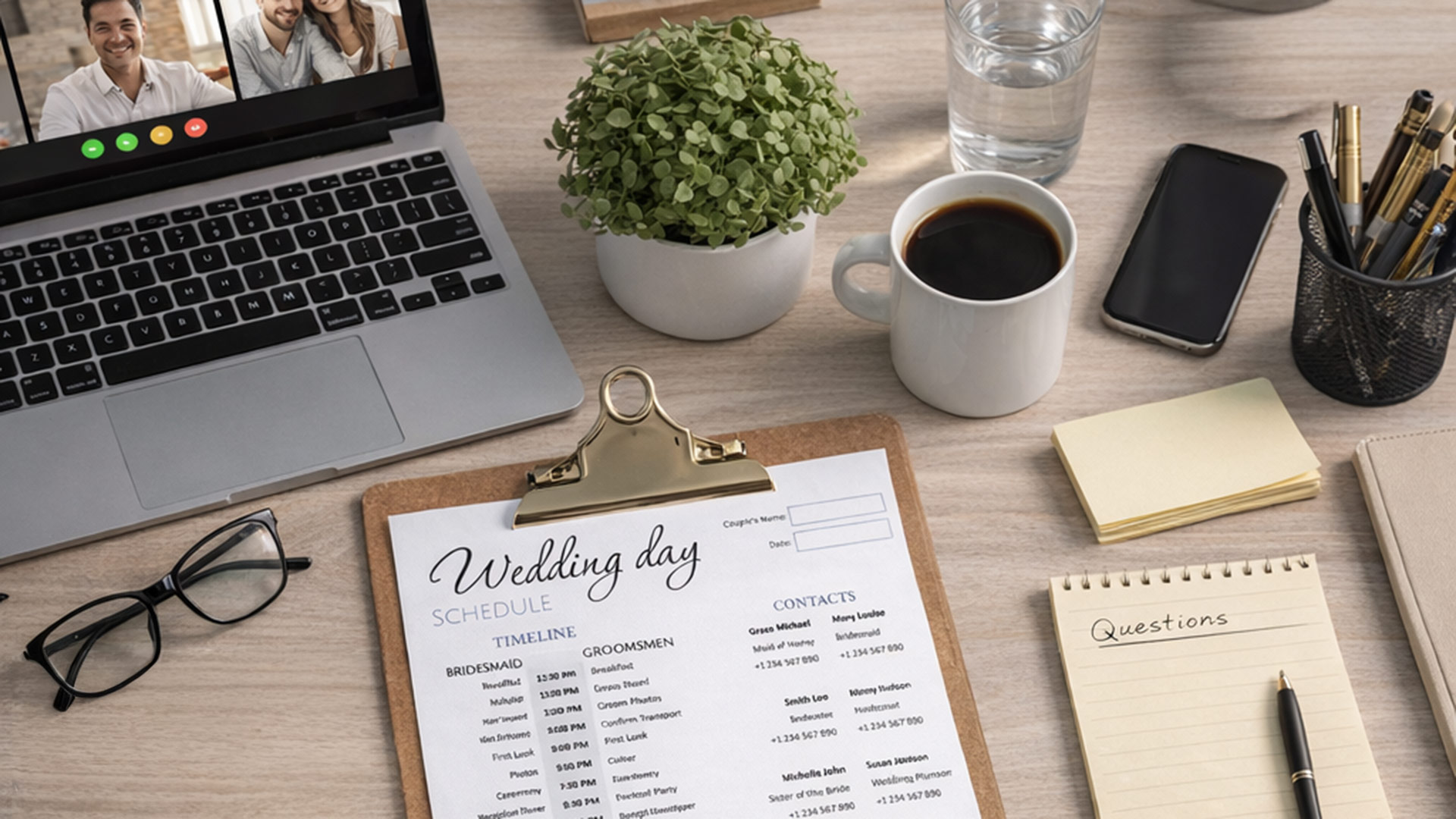
When couples tell us they want a “fun reception,” they usually mean one thing: they don’t want the night to drag.
The secret isn’t cramming more activities into the schedule. It’s building a timeline that protects energy, reduces awkward downtime, and gives your vendors the structure they need to execute.
This guide gives you a practical framework, plus sample timelines you can adapt to your venue and priorities.
One big 2026 reality: most couples do ceremony + cocktail hour + reception at the same venue. When the ceremony is offsite, the timeline doesn’t “break,” but you must plan for travel time (and the fact that guests don’t all leave at once).
If you want the “timeline + guest experience” view from multiple angles, these three posts pair perfectly with this one:
The #1 rule: Build your timeline around energy (not just tradition)
Your reception has natural “energy phases”:
- Arrival + cocktail hour: social, excited, not dancing yet
- Dinner: slower pace, conversation, toasts
- Formalities: spotlight moments
- Open dancing: the party phase
A great timeline keeps transitions smooth so guests feel like the night is moving forward, without feeling rushed.
The timeline framework that works for almost every wedding
Phase 1: Guest arrival + cocktail hour (60–90 minutes)
Goals:
- guests get drinks, mingle, find seats
- couple gets photos done (if needed)
- you set the tone with music and announcements (subtle)
Time-savers:
- If you want a relaxed, party-forward night, 90 minutes is often the sweet spot: it gives guests time for a second (or third) drink and helps the room feel settled before the dance floor opens.
- Assign a point-person for family photos so cocktail hour doesn’t silently turn into a 2-hour photo marathon.
- If it matters to you, a 90-minute cocktail hour can also allow: family photos first, then the couple can actually mingle during cocktail hour instead of disappearing the entire time.
- Keep cocktail hour music upbeat (not sleepy). It sets momentum.
If your ceremony is offsite:
- Build in travel time + buffer (traffic, parking, shuttles, late exits).
- Assume a staggered guest arrival. Plan your “welcome moment” accordingly (don’t start the program while half the room is still arriving).
Phase 2: Grand entrance + welcome (5–10 minutes)
Options:
- classic bridal party intros
- couple-only entrance
- no entrance (straight into dinner)
Time-saver:
- have names/pronunciations confirmed in writing
- keep intros tight; long intros can stall the room
2026 trend note: a lot of couples are moving grand entrance + first dance up front (right as the reception begins). It creates a clean “start,” gets a big moment done early, and lets you enjoy the rest of the night without waiting for “the program.”
Phase 3: Dinner service (45–90 minutes depending on catering)
This is where timelines often slip, especially with:
- buffet lines
- plated service delays
- bar lines and guest movement
Time-saver:
- confirm with catering when toasts should happen (before/after entrées)
- avoid stacking too many “moments” during dinner
Phase 4: Toasts (10–20 minutes)
The toast sweet spot:
- 2–4 speakers
- 2–4 minutes each
Time-saver:
- coach speakers: “2–3 minutes, one story, one toast”
- ensure microphones are ready and tested
When should toasts happen?
- After salad / early in dinner: guests are attentive, and toasts don’t interrupt the “party build.”
- After dinner: can feel more relaxed, but it risks a momentum dip right when you want to transition into dancing.
If you’re doing a “first dance up front” flow, toasts often land best after salad (or once the first course is down) so you’re not stacking all spotlight moments back-to-back.
Phase 5: First dance / parent dances (10–20 minutes)
Time-savers:
- consider shortening songs or fading around 2:30–3:00
- do first dance and parent dances back-to-back to maintain flow
Modern option (highly recommended for many couples):
- Grand entrance → first dance immediately (then dinner). It’s efficient, it feels intentional, and it keeps the night from turning into “waiting for the first dance.”
Phase 6: Dessert moment + optional traditions (5–15 minutes)
If you’re doing them:
- Cake cutting: keep it quick, photo-ready, and move on. (Or skip it entirely if you’re doing a dessert spread.)
- Dessert spread / late-night dessert: a great “mini reset” that doesn’t feel like a hard stop.
- Bouquet toss: happening less often now, but still fine to consider if it fits your crowd.
- Garter: we almost never see this anymore. Most couples skip it.
Optional “time hack”: The Photo Dash (1 song)
If you want photos with everyone without spending an hour bouncing between tables:
- The couple visits each table for one quick photo while the photographer follows.
- Do it to one upbeat song (your DJ/MC can frame it as a fun challenge).
- This works best right after salad or as dinner plates clear, before guests fully shift into dancing.
Phase 7: Open dancing (90–150+ minutes)
Time-savers:
- open dancing before cake can work well if guests are ready to party
- schedule a “dance set” before any late formalities to lock in energy
Sample reception timelines (realistic templates)
Template A: Classic flow (most common)
- 4:30 Ceremony
- 5:00 Cocktail hour (75–90 min)
- 6:00 Grand entrance + welcome
- 6:10 Dinner begins
- 6:35 Toasts (after salad / early dinner)
- 6:55 First dance + parent dances
- 7:25 Open dancing
- 8:15 Dessert moment (cake cut or dessert spread)
- 8:25 Open dancing
- 10:55 Last song
- 11:00 Exit
Template B: Party-first (for dance-floor couples)
- 4:30 Ceremony
- 5:00 Cocktail hour (90 min)
- 6:30 Grand entrance + first dance (up front)
- 6:40 Dinner begins
- 7:05 Toasts (after salad)
- 7:25 Open dancing (Set 1 begins)
- 8:10 Photo Dash (1 song) or quick dessert moment
- 8:15 Open dancing (Set 2)
- 9:30 Dessert reveal (or skip)
- 9:35 Open dancing (finale set)
Template C: Short cocktail + tight program (venue curfew)
- 5:00 Ceremony
- 5:30 Cocktail hour (60 min max)
- 6:30 Welcome + dinner begins
- 7:00 Toasts (tight)
- 7:20 First dance + parent dances (shortened)
- 7:45 Open dancing
- 9:50 Last song (hard stop at 10:00)
Two modern examples: 4-hour and 5-hour receptions (2026-friendly)
If you want your reception to feel “party-forward” without skipping meaningful moments, these two flows are great starting points.
Example 1: 4-hour reception (tight, energetic)
- 0:00 Welcome + dinner begins
- 0:25 Toasts (2–4 speakers, 2–3 min each)
- 0:40 First dance + parent dances (shortened)
- 0:55 Open dancing (Set 1: cross-generational builders)
- 1:25 Open dancing (Set 2: 90s/2000s sing-alongs)
- 2:05 Quick reset (dessert reveal or 1 slow song)
- 2:10 Open dancing (Set 3: current hits / high energy)
- 3:50 Last song
- 4:00 End
Example 2: 5-hour reception (more breathing room)
- 0:00 Grand entrance
- 0:10 Welcome + dinner begins
- 0:45 Toasts
- 1:05 First dance + parent dances
- 1:25 Open dancing (Set 1)
- 2:10 Open dancing (Set 2)
- 3:00 Open dancing (Set 3)
- 4:40 Last song
- 5:00 End
Dance set waves (how DJs keep floors full in 2026)
Instead of “one long open dance,” the strongest nights are built in waves:
- Set 1 (build): cross-generational anchors that pull people in
- Set 2 (peak): sing-alongs + nostalgia that keeps participation high
- Set 3 (finale): current hits / high energy closer
This approach prevents burnout and keeps people coming back even if they step away for a drink or dessert.
The “fake exit” trend: pros and cons
The “fake exit” (staged sendoff) is becoming more common in 2026: you do a sparkler/exit-style photo moment before the true end so photo/video can wrap.
Pros
- you get the iconic exit photos without paying for late-night coverage
- you can keep the party going after the staged moment
Cons
- some guests think the night is ending and leave
- it can interrupt momentum if it’s timed poorly
My preference: discourage it unless you truly need it.
Why? Because it’s one of the only timeline choices that actively tells guests “the night is over,” even if you say it isn’t. If your crowd is party-forward, you’re asking them to emotionally exit… then re-enter. That’s hard to do without losing people.
How to do it well
- If you must do it, announce it clearly: “Quick photo moment. Then we’re right back inside and the party continues.”
- Schedule it after a strong dance set, not at peak hands-up energy.
- Keep it short (5–10 minutes) and have the DJ ready to hit an instant set starter on re-entry.
- Make it obvious the bar and dance floor are still open (lights/music on, doors open, staff ready). If the venue “looks closed,” guests will leave.
Bottom line: fake exits can work, and sometimes they’re necessary for logistics, but they’re rarely the best choice for a dance-floor-forward night.
Optional moment: Anniversary dance (quick, meaningful, not cheesy)
If you want a moment that honors marriage without eating up time:
- Invite married couples to the floor, then have the DJ/MC ask couples with milestone anniversaries to stay (1 year, 5, 10, 20, 30, etc.).
- If you know in advance that parents/grandparents/aunt & uncle are celebrating a milestone, tell your planner/DJ so we can highlight it accurately.
- Keep it tight: one song, short prompts, done.
Modern cocktail-hour music ideas (so the night starts with momentum)
Cocktail hour is not background filler. It sets emotional tone. A modern 2026 approach:
- groovy pop + indie-pop: upbeat, not aggressive
- throwback R&B: familiar, warm, and romantic
- light remixes: recognizable but refined
Avoid a full hour of sleepy ballads. You want guests smiling, mingling, and feeling like the night is already moving.
What makes timelines fall apart (and how to prevent it)
“Too many moments” packed together
If you stack: entrance → welcome → prayer → toast → toast → toast → first dance → parent dances → cake → bouquet… guests feel like they’re watching a program, not celebrating.
Fix: group formalities, then open the floor.
Dinner delays nobody planned for
Buffets and catering bottlenecks happen. Build in margin.
Fix: avoid scheduling a hard-start moment (like first dance) too early after dinner starts.
Vendor coordination gaps
Your photographer, planner, venue, and DJ all need the same plan.
Fix: pick one “timeline owner” and share a final version with all vendors 1–2 weeks out.
The DJ/MC’s role in keeping flow
Even with a great timeline, the reception needs active management:
- cueing entrances
- confirming catering readiness before announcements
- staging toasts and microphones
- adjusting on the fly when a delay happens
This is where professional entertainment becomes more than “music.”
If you’re still deciding on the right entertainment format, read: DJ vs Band vs Playlist (2026 Edition): What’s Best for Your Wedding?.
If you want help building a timeline that fits your venue and priorities, explore wedding services or contact us.
FAQs
How long should a wedding reception be?
Most receptions run 4–5 hours. The “right” length depends on venue end time and how much you prioritize dancing.
Should toasts happen before or after dinner?
Either can work. Toasts before entrées often keeps guests more attentive; after dinner can feel more relaxed. Coordinate with catering timing.
Do we need a grand entrance?
No. Many couples skip it or do a couple-only entrance. What matters is having a clear “start” to reception so guests feel the shift.
How do we avoid awkward downtime?
Keep formalities tight, coordinate with catering, and avoid long gaps between key moments. A strong MC helps smooth transitions.