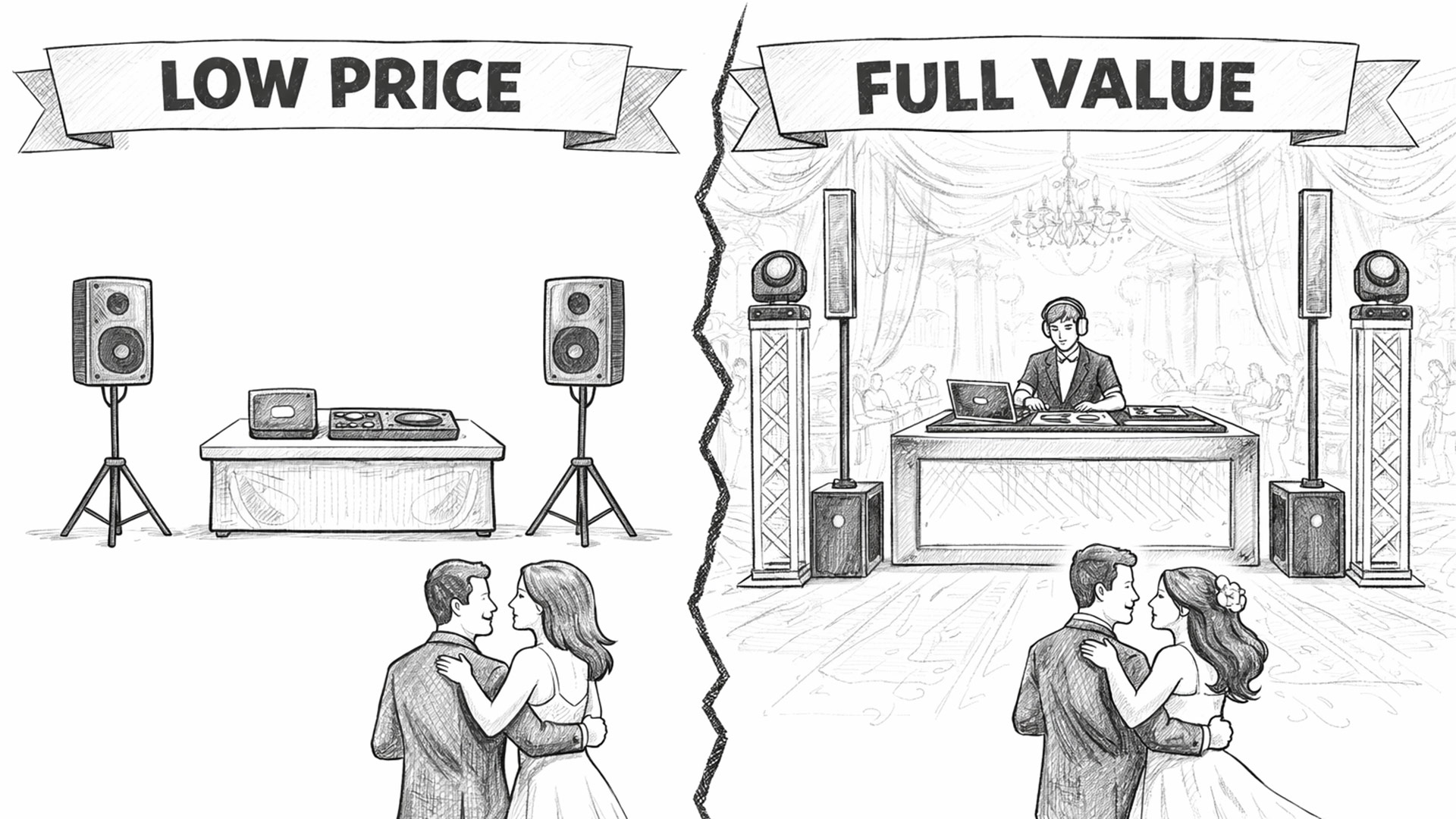
If you’ve started getting quotes for wedding entertainment, you’ve probably seen a wide range:
- One DJ is $1,200
- Another is $2,500
- Another is $4,000+
It’s tempting to assume you’re paying for “better songs.” You’re not. You’re paying for planning, production, reliability, and execution, and those are what make a reception feel smooth (or feel stressful).
This guide breaks down what wedding DJ pricing typically includes, what drives cost, and what to avoid when comparing quotes.
Why wedding DJ pricing varies so much
Wedding DJ pricing usually depends on five big variables:
- Coverage time (ceremony, cocktail, reception hours)
- Production level (sound + lighting + add-ons)
- Planning depth (consults, timeline help, coordination)
- Staffing (solo DJ vs DJ + MC + assistant/attendant)
- Risk management (backup gear, insurance, redundancy)
Two vendors can show up and “play music” for the same number of hours, but deliver completely different experiences.
What’s typically included in a professional wedding DJ price
Planning and prep (the hidden hours)
Most couples don’t see this part, but it’s a real chunk of the service:
- discovery call to learn your vibe + priorities
- building a timeline for ceremony/cocktail/reception
- collecting song requests, do-not-play, pronunciations
- coordination with planner/venue/photographer
- prepping clean edits for explicit songs (if needed)
- cue sheets for intros, toasts, special moments
If a vendor’s price seems low, ask what’s included in planning, because “planning” is often where corners are cut.
Professional sound (and how it’s deployed)
“Speakers” isn’t a strategy. Real coverage considers:
- room size, ceilings, and layout
- speech intelligibility during toasts
- ceremony audio that’s clear without feedback
- volume management (comfortable, not blasting)
MC services (if included)
If the DJ is also the MC, you’re paying for:
- clear, confident announcements
- pacing through dinner + formalities
- vendor coordination so moments land cleanly
- problem-solving when the schedule shifts
Setup, teardown, and transport
Wedding gear is heavy and time-intensive:
- load-in / load-out (often long walks, stairs, limited access)
- early arrival to be ready before guests
- teardown after the night ends
This is one reason venue type matters. A ballroom with easy access is different than a barn/outbuilding with uneven terrain and limited load-in.
Business basics (that protect you)
These don’t feel “fun,” but they matter:
- written contract
- liability insurance
- backup equipment standards
- tax-compliant business operations
Common package structures (and what they mean)
Reception-only
Best for: ceremony elsewhere, cocktail hour handled by venue.
Usually includes:
- one sound system for reception
- basic MC services
- dance floor lighting (varies by vendor)
Ceremony + cocktail + reception
Best for: one vendor handling the full audio flow.
Usually includes:
- ceremony sound + mics
- separate cocktail audio (or repurposed system)
- reception sound + MC
“Full production” (DJ/MC + lighting + extras)
Best for: transforming a space and creating a high-energy party.
Often includes:
- uplighting (room transformation)
- intelligent/dynamic lighting for dancing
- enhancements like monogram, cold sparks, or photo booth (depending on company)
What upgrades are usually worth it (from a guest experience standpoint)
1) Ceremony audio done right
Guests remember vows they could hear.
Look for:
- high-quality microphones
- coverage for the full seating area
- solutions that don’t require ugly cable runs
2) Uplighting (if your venue needs “warmth”)
Uplighting often delivers the biggest visual impact per dollar because it affects the whole room.
3) An actual MC (if your vendor separates roles)
If your reception has a lot of moving parts (big bridal party, multiple toasts, cultural moments), having a dedicated MC or a DJ who is truly strong on the mic can be a game-changer.
4) Photo booth (when you want built-in guest engagement)
It’s not “extra entertainment.” It’s a social hub, especially for guests who don’t dance much.
What to avoid: the “cheap now, expensive later” traps
“I’ll just use the venue’s system”
Venue systems vary wildly. Some are great; many are not optimized for:
- clear speech for 150+ guests
- microphone quality and feedback control
- smooth transitions across spaces
“Sound-active lights are included”
If the lights blink randomly to the bass all night, you’re not getting “wedding lighting.” You’re getting party lights.
“No backup gear”
Gear fails. Pros plan for it. If they don’t, you’re taking on the risk.
“The quote is vague”
If you can’t tell what you’re paying for, you can’t compare vendors, and you may get surprise fees later.
A simple way to compare quotes (scorecard)
Give each vendor a 1–5 rating on:
- Planning process clarity
- MC skill and style fit
- Ceremony audio quality
- Backup standards
- Lighting quality (if offered)
- Communication speed and professionalism
The highest score usually wins, even if it’s not the lowest price, because it reduces risk and stress.
The bottom line
Wedding DJ pricing isn’t about paying for “songs.” It’s paying for a team that can deliver:
- clear audio
- smooth flow
- confident hosting
- a packed dance floor
- backups and professionalism
If you want help comparing quotes, we’re happy to talk through what’s included and what questions to ask.
Next step: Check availability or learn more about our wedding services.
FAQs
How much does a wedding DJ typically cost?
It depends on coverage time and production level. Reception-only is usually less than ceremony + full production. The key is comparing what’s included.
Why are some DJs so much cheaper?
Common reasons: less planning, less gear, no insurance, no backups, or part-time operations. Sometimes that’s fine. Sometimes it’s risky.
Is lighting usually included?
Often basic dance lighting is included, but uplighting and intelligent lighting are usually upgrades. Ask whether lighting is sound-active or DMX-controlled.
Can we book a DJ without an MC?
Yes, but someone must run guest-facing flow. If you don’t want an MC, discuss how announcements and formalities will be handled.